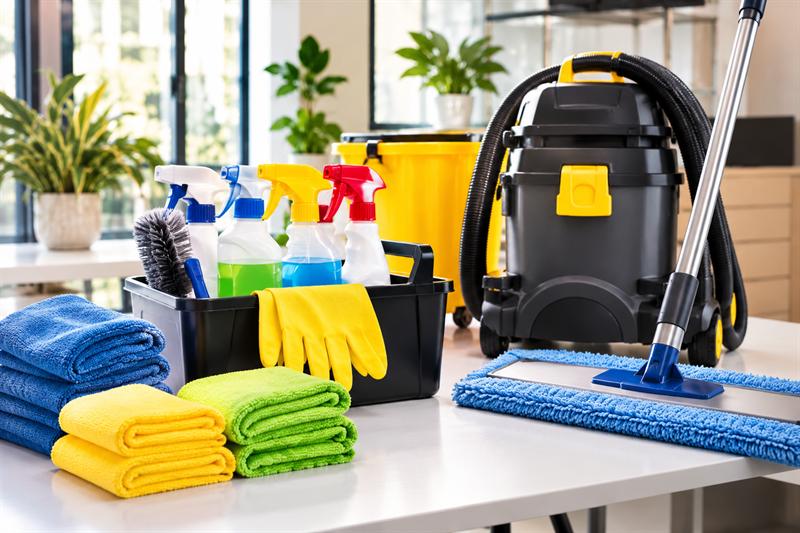
Construction dust keeps settling for days. Here's how to get ahead of it.
Everyday 3 min read
Clean in the right order: top to bottom, dry to wet
The biggest time-waster in cleaning isn't a lack of effort. It's cleaning in the wrong order. Wipe the counters first and dust the cabinet tops second, and the dust lands right back on your clean counters.
Our crew follows three rules in every room:
Top to bottom. Start with ceiling fans, light fixtures, and the tops of cabinets and door frames. Finish with the floor. Dust falls; let it fall onto surfaces you haven't cleaned yet.
Dry to wet. Dust and vacuum before you spray anything. Wet cleaner on dusty surfaces turns dust into streaky mud.
Clean to dirty. Do the least-dirty areas first so your cloths and tools stay cleaner longer. In a bathroom, the toilet is always last.
Bonus: finish one room completely before moving to the next. You'll never lose track of where you left off, and you'll never miss a zone.
If the same cloth wipes your toilet and your kitchen counter, you're not cleaning. You're moving bacteria around. Professional cleaners prevent this with a color-coding system, and it's easy to copy at home.
Buy microfiber cloths in a few colors and give each color one job:
One color for toilets and urinals only. These never go anywhere else, ever.
One color for bathroom sinks, tubs, and showers.
One color for the kitchen and anywhere food is prepared or eaten.
One color for everything else: dusting, glass, furniture, and electronics.
Write your system on a sticky note inside the cabinet where you keep supplies so everyone in the house uses the same one. Wash cloths in hot water, and skip fabric softener: it coats microfiber and stops it from grabbing dust.
Most people spray a disinfectant and wipe it off right away. Unfortunately, that usually means the product never had time to work.
Every disinfectant label lists a contact time (sometimes called dwell time): how long the surface has to stay visibly wet to kill the germs listed on the label. It can range from under a minute to ten minutes, depending on the product.
Clean first, then disinfect. Disinfectants don't work well through grime, so wipe away visible dirt before you spray.
Read the label for the contact time, then leave the surface wet that long. Spray, move on to the next task, and come back.
Follow the dilution ratio exactly. More product isn't stronger; it just leaves residue.
Never mix products, especially bleach with ammonia or acids. The fumes are dangerous.
Focus on the high-touch spots: door handles, light switches, faucet handles, remotes, and the fridge handle.
An empty home shows everything. Once the furniture is gone, the dust lines, cabinet crumbs, and greasy appliances are front and center. Here are the ten spots that most often get missed:
Inside the oven and the drawer underneath it.
Inside the fridge and freezer, including the drawers and the door seals.
Inside every cabinet and drawer, especially under the kitchen and bathroom sinks.
Baseboards throughout the home, hand-wiped, not just vacuumed.
Window sills and tracks, plus sliding-door tracks.
Light switches and outlet covers. Fingerprints add up over a lease.
Vent covers and return grilles.
Closet shelves and floors.
The range hood and filter. Grease builds up fast.
Trash cans that came with the unit, washed, not just emptied.
Take dated photos of every room when you're done. They're your best proof of the condition you left it in.
Moving soon? Our move-in/move-out clean covers all of this, inside and out.
Drywall and sanding dust is incredibly fine. It hangs in the air for hours, settles into every crevice, and keeps drifting down for days after the work is done. That's why post-construction cleaning is a different job from a regular deep clean.
Don't dry-sweep. A broom just throws fine dust back into the air. Use a vacuum with a HEPA filter, then damp-mop.
Work top to bottom. Vents, light fixtures, door tops, and window frames first; floors last.
Plan for more than one pass. Dust keeps settling, so a second wipe-down a day or two later catches what the first one couldn't.
Check inside everything. Cabinets, drawers, closets, and outlet boxes all collect dust.
Change the HVAC filter once the dust has settled, or the system will keep blowing it around.
Be careful with new surfaces. Fresh paint, stone, and finishes can scratch or stain with the wrong product, so check with your contractor about what's safe.
Finishing a renovation or build? We handle post-construction cleans across the DMV.